
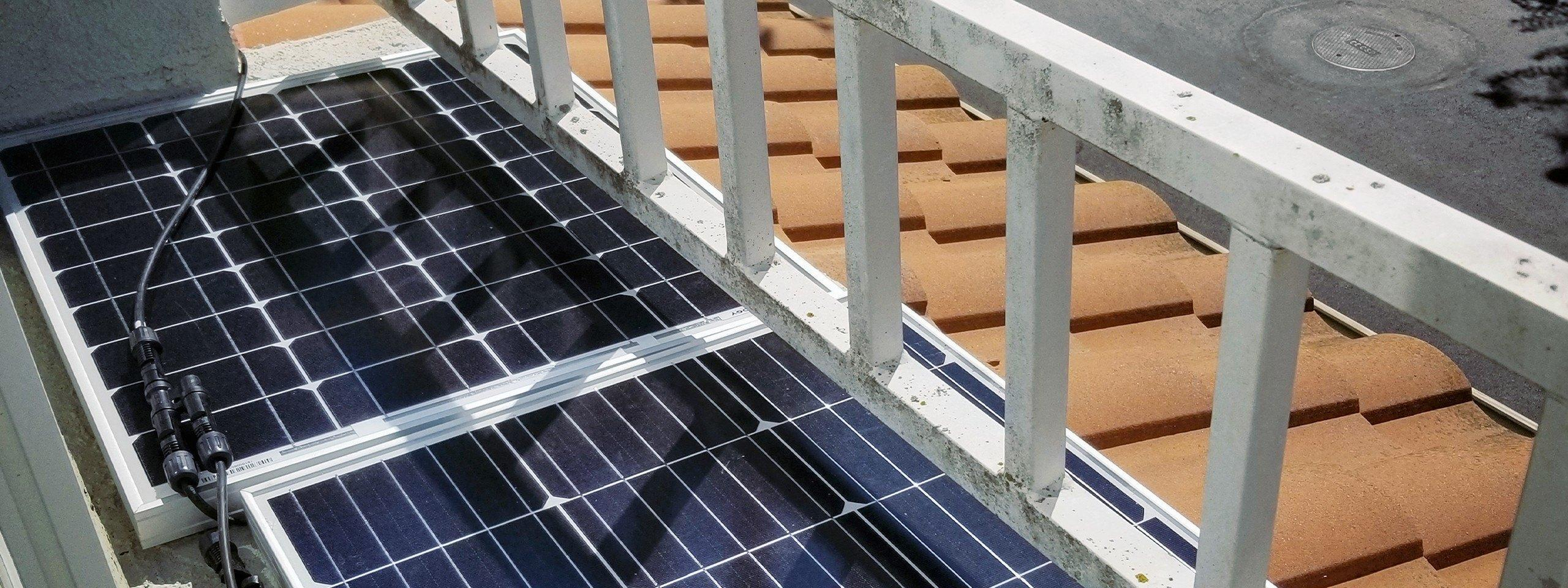
As States Legalize Plug-In Solar, Safety Standards Race To Catch Up
On Tuesday, New Jersey Gov. Mikie Sherrill signed a bill designed to make it easier for residents to generate their own electricity by using small solar systems that plug directly into a household outlet.
“Balcony solar is the ultimate win-win,” Sherrill said after plugging in a solar panel at the bill-signing ceremony. “It’s accessible, affordable, safe, and sustainable.”
The appeal is easy enough to understand. Plug-in photovoltaic (PIPV) systems can cost hundreds of dollars rather than tens of thousands for rooftop solar (BIPV), and they could shave as much as $50 off a household’s monthly electricity bill, according to Sherrill.
But experts warn that the safety of plugging one into a home is far more complicated.
“Our advice for consumers would be wait,” Ken Boyce, vice president of principal engineering at UL Solutions, a product testing and safety science company, tells Realtor.com®. “Wait until you can get a PIPV system that has been shown to comply with the UL 3700 requirements, because that is what will keep you and your family safe.”
UL began studying the technology as states moved to legalize it and identified potential fire and shock hazards. Those findings helped shape UL 3700, a new safety framework developed specifically for PIPV systems.
New Jersey built that standard directly into its law—to qualify, a system must be listed or certified under UL 3700, or a comparable set of standards. But none of the commercially available products UL examined in its research cleared that bar.
“We didn’t test every product that’s available in the market, but we did acquire products that are commercially available when we did our research,” Boyce says. “None of those products that we tested would comply with the UL 3700 requirements.”
The risk starts before you even plug in
A PIPV system works exactly the way you might expect: Solar panels collect sunlight, an inverter converts their electricity from DC to AC, and the system plugs into an outlet. But that familiarity is also part of the risk.
“PIPV systems use that very familiar cord and plug approach for a very, very different usage,” Boyce explains.

Consider, for example, the plug on a lamp. You know not to touch the metal prongs while they’re connected to an outlet. Once the lamp is unplugged, though, you probably wouldn’t think twice about them.
Plug-in solar works differently. Because the panels themselves generate electricity, the plug’s metal prongs can remain energized even after they're pulled from the wall. As long as the panels are collecting light, touching those prongs can pose a shock hazard.
“There is a risk, unless there are appropriate safety measures implemented, that someone could touch those plug blades and receive an electric shock,” Boyce says.
The systems operate at the same 120-volt alternating current used in U.S. homes.
“It’s serious. I will say it’s serious,” Boyce adds. If it passes through the heart, “the electricity can cause the heart to malfunction, and it can lead to death.”
What happens after you plug in a PIPV
Sending power backward through an existing household circuit can create problems deeper in the electrical system, too.
Normally, circuit breakers trip before too much current overloads household wiring, but plug-in solar can bypass that safeguard.
“When you plug in a PIPV product into a receptacle, those circuit breakers are blind to that additional current,” Boyce explains. “They can’t see it.”
UL illustrates the problem with a 15-amp circuit. If appliances are drawing 20 amps, a 15-amp breaker should trip. But if plug-in solar supplies 5 of those amps downstream, the wiring can still carry 20 amps while the breaker sees only 15.
“You could take the current from the grid plus the current from the PIPV system, and together that could overload those wires and electrical connections and cause a fire,” Boyce says.
The danger may develop without an obvious warning, too.
“You can get glowing receptacles that can start a fire,” Boyce says. Add more electrical demand later, and “you’re starting to damage the insulation. You’re starting to get glowing conductors or glowing connections.”
UL also found that plug-in solar can interfere with some ground fault circuit interrupters, or GFCIs—the familiar “test” and “reset” devices that protect against electric shock.
In UL testing, a GFCI breaker interrupted a simulated fault in 12.6 milliseconds on average without an inverter feeding the circuit. With an inverter connected, all three configurations exceeded the applicable threshold.
“If you backfeed them, you have current going the other way through those protective devices; you can damage them,” Boyce explains. Even more concerning, he says, the power can stay on after the protection is lost.
“It could be damaged in such a way that it continues to provide power, electrical power, but you’ve lost all the protection,” he says. “So there’s this insidious aspect.”
UL says those hazards can be engineered out—but it needs to be implemented in the complete system, rather than assuming separately certified components will be safe when combined.
“It’s really important to look at that as a system,” Boyce says. “Will that assembly that you have now created into a system actually comply with the system requirements? It may or may not.
“The thing is, you want to know that it does.”
And the danger can outlast the resident
Portability is one of plug-in solar’s selling points—a renter can bring a system into an apartment and take it when they move. But damage to the apartment’s electrical system may not leave with them.
Boyce asks homeowners to imagine a renter or condo owner using a system without those protections.
“They plug them in. They start to degrade the wiring in the wall because it’s being overloaded. They’ve damaged GFCIs. They won’t work anymore to provide protection, and they move,” he says.
“They take their PIPV product with them, but that damage is still there in that building.”
And the next resident may have no idea anything happened.
“The next people who move into that residence are exposed to these hazards that they have no way of even knowing about,” Boyce says.

An electrician can test a faulty GFCI, but damage to wiring hidden inside walls can be harder to rule out.
“They’re probably not really going to be able to practically look at the wiring that’s inside conduits, so it becomes a little bit difficult to gauge that real-world degradation and damage that could lead to a hazard,” Boyce says.
Why states are turning to plug-in solar
Boyce is careful to say that these risks aren’t a reason to write off plug-in solar. Instead, they’re a reason to make sure the systems are properly tested before they reach consumers.
“The good news is there are ways to address those hazards,” Boyce says. “But they have to be addressed.”
UL is now evaluating systems seeking certification. At the same time, the pressure to make cheaper sources of electricity available is only growing.
Electricity consumption is expected to be higher this season than in any of the previous five summers, according to the Federal Energy Regulatory Commission.
At the same time, utility rates have continued a steady climb upward—the national average residential electricity price is about 18 cents per kilowatt-hour in 2026—roughly 37% higher than in 2020, according to the U.S. Energy Information Administration.
By that measure, it's easy to see why so many lawmakers are pushing to make adoption of plug-in solar easier. California lawmakers sent the Plug and Play Solar Act to Gov. Gavin Newsom last week, while New York’s SUNNY Act is awaiting action from Gov. Kathy Hochul.
Utah started the movement in 2025, becoming the first state to specifically legalize plug-in solar. Its law also helped set UL’s safety work in motion.
“When we saw that Utah had actually passed that first bill related to plug-in PV ... we had really not done anything specific on PIPV up to that point,” Boyce says.
UL then brought together experts on solar panels, inverters, and electrical protections to study how the systems could interact with U.S. homes.
“We had a team really focused on looking at all the different aspects of this to really understand what the potential safety hazards would be,” he says.
For Boyce, the goal is to make that expansion possible without leaving safety behind.
“We want people to be able to participate in the energy transition and generate their own electricity, but we have to keep them safe when they do it,” he says. “It has to be both of those things.”