
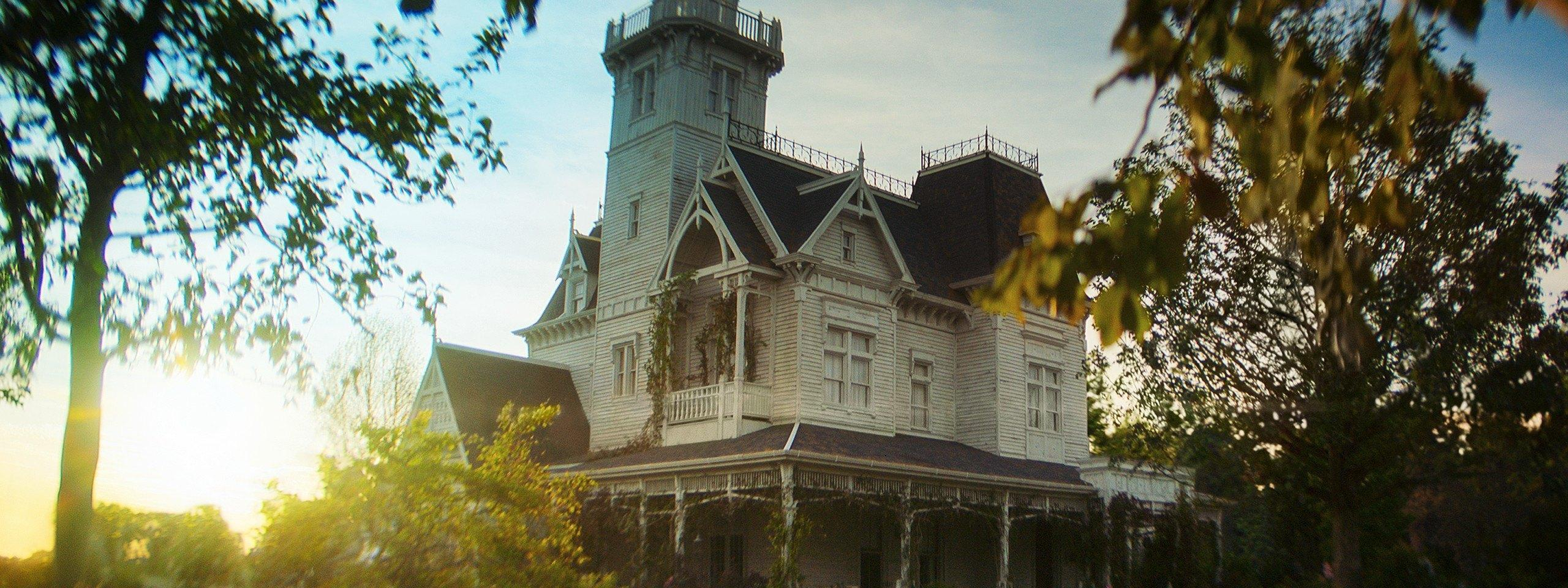
The ‘Practical Magic’ Mansion: What This Cult-Classic Home Would Actually Cost You Today
Spooky season is quickly approaching, and "Practical Magic 2" hits theaters on Thursday. If you're anything like us, you've probably spent time dreaming about the house from the 1998 original.
But as it turns out, director Griffin Dunne couldn’t find a real-life home that matched his vision for the iconic Owens sisters' family home. He actually hired production designers Robin Standefer and Stephen Alesch to build a temporary exterior shell on Washington’s San Juan Island for the film. The famous movie house’s detailed rooms were constructed on a soundstage in Los Angeles.
While the house was never real, moviegoers have obsessed over it for nearly 28 years. So what would it cost to buy a historical home and live like Sandra Bullock and Nicole Kidman's witchy characters today?
To know for sure, let's break down the math for two separate 1890s Victorians: the first in Coupeville, WA, where the movie’s town shots were filmed, and another in the coastal town of Winthrop, MA, which is similar to the movie’s intended New England vibe.
What it takes to finance a historical Victorian
Unlike the Owens sisters, who lived with their aunts in an inherited Victorian, you'll likely need a mortgage to buy an 1890s Victorian in a coastal town in Washington or Massachusetts. Historical homes can qualify for conventional financing, and for homes priced within conforming loan limits, buyers may qualify with as little as 3% down.
For homes that exceed the $832,750 conforming loan limit, buyers will need a jumbo loan. Since these loans pose more risk to lenders, buyers should expect a larger down payment requirement, a strong credit profile, and sufficient cash reserves to cover several months of mortgage payments after closing.
Dean Rathbun, executive vice president of United American Mortgage Corp., says jumbo loans can go as low as 10% down on loan amounts of up to around $1.5 million.
For properties that exceed that threshold, buyers should expect a minimum 20% down payment, which eliminates the need for private mortgage insurance. Buyers should also plan to have sufficient cash reserves to cover at least six months of mortgage payments after closing.
Rathbun notes that lenders will also evaluate whether comparable historical homes have sold nearby and whether any restrictions on the property could affect the home's resale value.
Insuring a historical home
Before you fall under the spell of an 1890s Victorian, make sure you know what home insurance on a property like this actually costs. When it comes to determining premiums for a historical home, the math works differently than for a standard house.
Tom Firestine, principal at Longmeadow Insurance in Wilmette, IL, says premiums are based on the home's replacement cost, meaning the cost to rebuild with materials of like kind and quality. For a standard home, that's easy to estimate. But for older, unique homes, insurance companies send out an inspector.
“A builder-grade, 3,600-square-foot Colonial might rebuild at $250 to $325 per square foot. An 1890s Victorian with plaster walls, custom millwork, a turret, leaded glass, and a slate or cedar roof can run $450 to $1,200 per square foot because you are paying for craft labor and salvage-matched materials,” Firestine explains.
To save money, many homeowners with older homes buy policies on a functional replacement-cost basis.
“Rather than replace plaster walls and ornate woodwork, the insurer is permitted to use drywall and standard trim to rebuild the house functionally the same,” says Firestine.
He notes that updating an 1890s Victorian's heating, plumbing, and electrical systems can bring insurance rates in line with those of a modern home, but premiums are higher due to the cost of rebuilding.
Firestine warns buyers not to overlook ordinance and law coverage. A standard insurance policy pays to rebuild the home as it was, but it won't cover the cost of bringing it up to current building codes. That's where ordinance and law coverage steps in.
“Ordinance and law coverage pays the additional costs to reconfigure stairs that are too steep, widen hallways, add code-required seismic protections, or hurricane and flood protections,” he explains.
Firestine reminds buyers that insurance is local, even when dealing with a multinational insurer.
“The ISO rating of the local fire department, what the roof is covered with, and how elevated the house is above a body of water matter,” he says. “Insurers' risk modeling is sophisticated, and two adjoining lots can be wildly different in insurance rates applied to a similar house.”
Not every insurer will cover a historical home. Grant Owens, chief product and underwriting officer at Openly, says homes listed on a historic registry may have fewer insurers willing to insure them. In these situations, buyers may need to seek coverage from a specialty or high net worth carrier.
“For someone considering a property like this, insurance shouldn't be an afterthought in the buying process,” says Owens. “I'd recommend talking to an independent agent early on to understand what coverage is available.”
What it costs to own a real-life magical mansion
Here's what it costs to own an 1890s Victorian in two different coastal towns.
Coupeville, WA: 501 Northeast Ninth St.


This is a 3,599-square-foot, four-bedroom, three-bath Victorian built in 1894, currently listed at $1,695,000. Let's assume a 20% down payment and a 30-year fixed-rate jumbo mortgage at 6.728%.
- Purchase price: $1,695,000
- Down payment: $339,000 (20%)
- Loan amount: $1,356,000
- Property tax rate: 7.4583 per $1,000 of assessed value
- Property taxes: $12,641.82 per year ($1,053.48/month)
- Estimated reconstruction cost: $1.8 million to $2.4 million
- Insurance: $7,000 to $14,000 per year ($600 to $1,150/month)
- Estimated monthly payment (principal, interest, property taxes, insurance): $10,428 to $10,978
Coupeville sits in the Cascadia subduction zone. Earthquake coverage is not included in the insurance estimate and could add $2,000 to $5,000 per year with a deductible of 10% to 15% of the replacement cost. On a home insured for $2.1 million, that’s $210,000 to $315,000 out of pocket.
Winthrop, MA: 191 Cottage Park Road

(Anthony Giacalone/Tony’s Realty)


This is a 4,455-square-foot, six-bedroom, 3.5-bath Victorian built in 1890, which was sold for $1,665,000 in spring 2026. Let's assume a 20% down payment and a 30-year fixed-rate jumbo mortgage at 6.728%.
- Purchase price: $1,665,000
- Down payment: $333,000 (20%)
- Loan amount: $1,332,000
- Property tax rate: 11.14 per $1,000 of assessed value
- Property taxes: $18,548.10 per year ($1,545.68/month)
- Estimated reconstruction cost: $2.4 million to $3.2 million
- Insurance: $13,000 to $28,000 per year ($1,100 to $2,300/month)
- Estimated monthly payment (principal, interest, property taxes, insurance): $11,266 to $12,466
The insurance estimate doesn't include flood coverage, which could add $4,000 to $11,000 per year, given the property's proximity to the harbor. Buyers should anticipate a separate hurricane deductible of 1% to 5% of the insured value. On a home insured for $2.6 million, that’s $26,000 to $130,000 out of pocket.