
The ‘Ghost Condos’ of L.A.: Why Is a Chinese State-Backed Company Holding Hundreds of Empty Units?
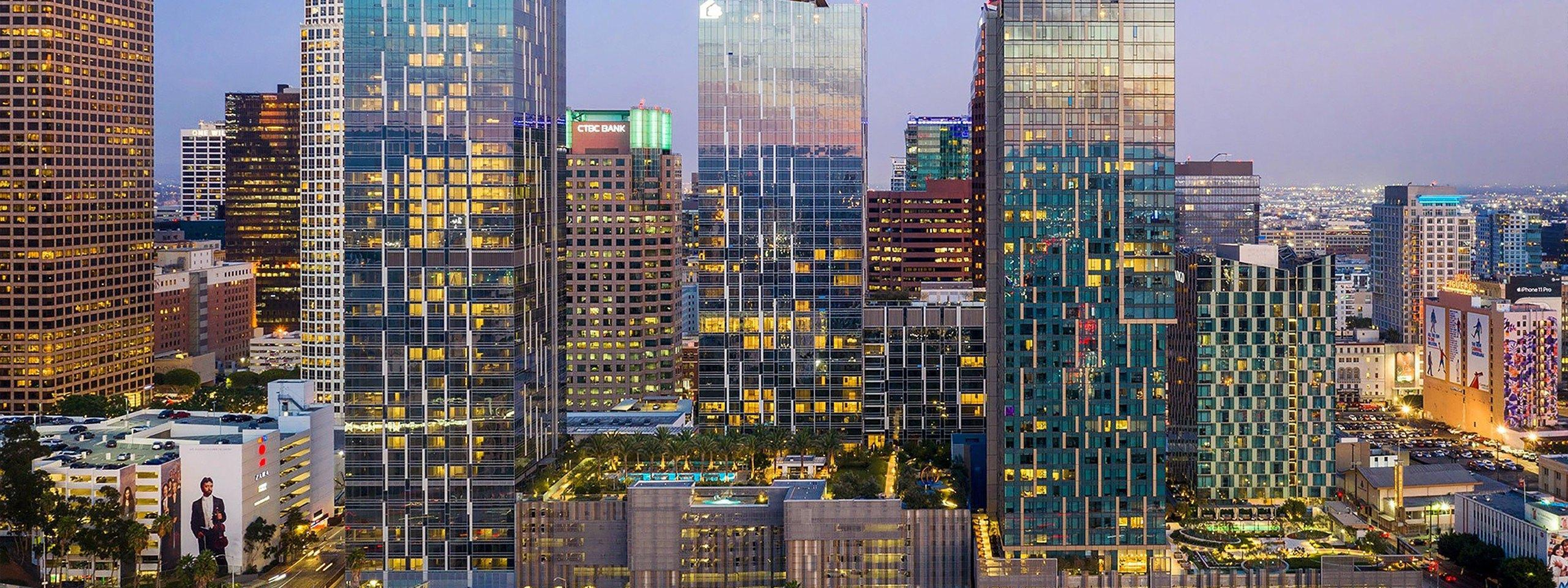
In the middle of Los Angeles, four gleaming skyscrapers stretch toward the clouds.
The glass-fronted development, dubbed Metropolis, includes two condo towers, one rental tower, and the luxury Indigo Hotel. All told, the block-long expanse includes more than 1,500 residential units. Its developer, Greenland USA, describes the complex as “a vibrant oasis where residents are privy to expansive spaces to gather and entertain, plus more intimate settings to work, dine, and unwind.”
But on a recent trip to its downtown L.A. location, independent journalist Yoonj Kim found that the towers seemed half-deserted.
Kim was investigating the long-whispered rumors that Metropolis was nothing more than a glittering ghost town.
What she found, and what Realtor.com® independently verified, is that nearly a third of the condo units in the Metropolis towers are vacant, either because they were sold to absentee Chinese investors who never moved in, or because the properties were never put on the market.
Seven years after the complex was completed, developer Greenland USA, the American subsidiary of Shanghai-based developer Greenland Holding Group, still owns hundreds of units across both condo towers.
A review of records from 889 Francisco and 877 Francisco, the addresses of Metropolis' two towers, found that only 71 of 844 units took a homeowners exemption—a $7,000 property tax exemption given to homeowners on their primary place of residence—in 2025.
Because homeowners aren't required to take the exemption, it's hard to say how many people actually use the towers as their primary residences. However, other condo buildings in the area had an exemption rate between 50% and 60%. Meanwhile, at 877 Francisco only 6% of condo owners took the exemption, and at 889 Francisco, just 13% did.
So what might be happening? Well, one hint is on the developer's own website, where alongside standard social media links for Instagram and Facebook, there is a link for Weixin, the Chinese version of WhatsApp.
Despite its name, Greenland Holdings is unrelated to the Arctic island. Instead, the company is a Chinese state-backed entity that is 46% owned by the Shanghai municipal government.
Chinese investment in West Coast real estate
California, and Los Angeles and San Francisco specifically, have long been a key destination for wealthy Chinese investors. The relative proximity of the West Coast to mainland China made it an attractive destination for individual investors and commercial enterprises looking to park their money.
The story of Metropolis dates to 2013, when Greenland USA, the American subsidiary of Greenland Holdings, announced it would be investing $1 billion in a multibuilding complex in downtown L.A.

At the time, Chinese business development in the U.S. real estate market was on the rise. Global real estate firm Jones Lang Lasalle reported that Chinese firms invested more than $5 billion in the U.S. market in 2013. That year, a National Association of Realtors® report found, Chinese buyers spent around $22 billion in the U.S. real estate market—more than half of which was in California.
But in 2017, the Chinese government, fearing a weakened yuan, began cracking down on foreign investment. Real estate transactions slowed. In 2016, China invested $16.2 billion in commercial real estate in the U.S. The following year, that figure dropped to $7.3 billion, and in 2018 it nearly halved again.
More recently, Chinese buyers have been hobbled by growing economic instability at home and a collapsing real estate market in their own country. Even so, Chinese buyers spent $7.6 billion on U.S. properties in 2026. And despite Beijing closing ranks on foreign investment, Chinese buyers continue to find ways to get their money out.
Metropolis is just one of several major projects from Greenland, which is also responsible for the much beleagured Atlantic Yards project in Brooklyn. Greenland lost control of that project in 2025 after defaulting on more than $286 million in loans it raised from immigrant investors through an EB-5 visa program.
Under the EB-5 visa program, investors and their families are eligible to apply for lawful permanent residence and become green card holders if they make a minimum investment of $1,050,000 and plan to create or preserve 10 permanent full-time jobs for qualified U.S. workers.
Around $100 million in funds for the development of Metropolis was raised through an EB-5 visa investment program, which may explain why so many of the deeds in the towers are held by people of Chinese descent—and why the buildings appear to be largely vacant.
The empty units are especially jarring given that Los Angeles is in the midst of a housing crisis. Despite the city losing around 10,000 residents last year, some estimates put the shortfall at around 500,000 units.
Even so, Shane Phillips, an urban planner and policy expert with the UCLA Lewis Center Housing Initiative, says that concerns about housing shortages in L.A. are overblown.
"Overall vacancies in Los Angeles are and have been for probably decades much lower than the average city," he says. "When demand is high, people tend not to waste housing by just keeping it vacant."
And, he says, just because people aren't living in those buildings doesn't mean that they're not contributing to the community. By his estimates, the Metropolis towers are contributing around $15 million in property taxes each year.
"Vacancies are bad," Phillips says. "We should minimize vacancies. But the one little kind of silver lining there is if people are not living there, they're not really using services, and so they're just paying a bunch of money into the city's general fund budget but not using schools, not using police services, not using all these things that other residents are."
Still, he concedes that the general vibe of the area is negatively affected by the lack of residents. Phillips recalls being on a panel at a conference held at the Hotel Indigo recently and noting that the area was "fairly dead."
"It's not a very great place for walking in general. It's right next to the freeway. Having at least some more people [on the streets] discourages cars from driving too quickly through the community."

Why is the Greenland holding on to so many units?
Perhaps the most puzzling piece of the Metropolis story isn't the vacancies, but what's behind them. Across both condo buildings, a full third of all units are owned by Greenland Development II LLC and were seemingly never put on the market.
"A developer may hold on to unsold or unrented units for a variety of reasons: to protect comps, to avoid realizing losses, to wait for the right kind of buyer, or simply to keep capital parked in a U.S. asset," says Realtor.com senior economist Hannah Jones.
"Every unit sold or leased at a discount sets a new benchmark for the rest of the building, so a developer sitting on hundreds of units has little incentive to sell below its target price and risk dragging down the value of everything else it owns there.
"Holding on to inventory also lets a developer defer, rather than lock in, a loss until market conditions improve," she continues. "In some cases, a developer may prefer to offload many units at once to a single buyer rather than sell them off one by one, which can simply take time to arrange. And for some foreign owners, the goal of a property may be less about generating income than about holding a stable, dollar-denominated asset in the U.S."
Regardless of the reason, residents say that Greenland has failed to cover its share of HOA fees in the buildings. Last year, some filed a lawsuit against Metropolis Master Association—the buildings' HOA—claiming Greenland owes around $6.8 million in unpaid HOA dues on the condos it owns.
That loss of funds, the lawsuit alleges, meant the HOA struggled to pay vendors, leaving the high-rise towers in one instance within hours of losing water and electricity. The suit also claims HOA management used funds from tower I to cover expenses in tower II and that maintenance was deferred because of a reserve fund deficit.
Ultimately, though, Greenland may see that problem as small potatoes: In early September, Greenland Holdings, the parent company of Greenland USA, reported that it's carrying more than $4.9 billion in overdue debt and facing 942 lawsuits from a variety of creditors.
Greenland USA did not respond to requests for comment.