
Former 1847 Ohio Jail Goes Under Offer for $400K: How One Family Turned Inmate Cells Into Pantries and Closets
When most people sit down for Sunday dinner, they aren't staring directly into 19th-century jail cells. But for listing agent Caroline Hoffmann, having remnants of 19th-century law enforcement in the dining room was just part of normal family life.
The historic Old Wood County Jail at 240 W Indiana Ave in Perrysburg, OH—currently under contract with a contingent offer on its $400,000 listing—isn't just an unusual piece of real estate to Hoffmann. It’s her family’s legacy.
"I think the fact that it still has the original jail cells intact is what really gets people's attention all the time," Hoffmann says. "Everybody wants to know if it's haunted. It's not."


While the 2,960-square-foot brick property was originally constructed in 1847 and functioned as a county lockup until 1870, its modern history is deeply personal. The building served as the city jail until 1899, after which the public record goes quiet until 1918. That’s when Hoffmann’s family history with the structure began.
“My great-great-grandfather bought it from his brother-in-law in 1924. His brother-in-law had purchased it in 1918,” Hoffmann explains.
The structure was subsequently converted into three individual apartments—one on the lower level and two on the upper floor, each configured with one bedroom, a bathroom, and a small kitchen. Over the decades, it operated as a steady investment property.
“I have several acquaintances and friends that have been former tenants in the building,” Hoffmann says.
The building’s path shifted about 15 years ago when Hoffmann’s parents moved back to Ohio and decided to make the historic property their primary residence.
“About 15 years ago, my father decided to let all the leases lapse and then he and my mom moved in and just used the whole thing as one house,” Hoffmann explains.
Though each apartment remained self-sufficient and connected via a central interior hallway, opening the interior doors allowed the family to live across the entire space seamlessly.
“My father used the downstairs apartment bedroom as his office and then when he passed away, we just used that as a guest room,” she says. “We used the downstairs living room for family events and where we would have friends over. We didn't waste any space when we lived in there as one family.”


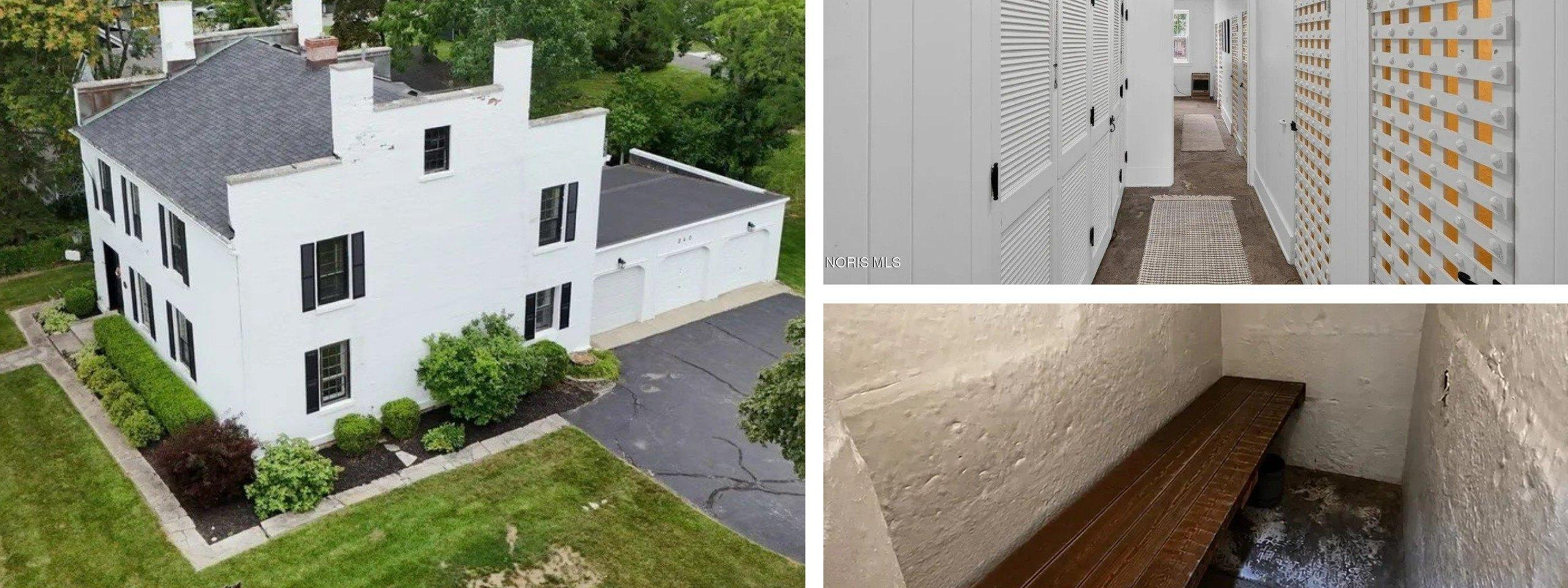
The focal point of the main floor remains the dining area, where six historic jail cells line the wall directly opposite the dining table.
“[The cells] are part of the dining room because that's the best room in the house to fit a table,” Hoffmann explains. “The way that it's set up, that area where the jail cells are is just really the easiest place to have a table. So that's how that ended up as the dining room.”
Today, five of the lower-level cells have been retrofitted for practical residential storage, functioning as walk-in closets, china cabinets, or pantries, complete with replica wood doors. However, one cell was intentionally left in its original state to honor the building's past.
“One of them still has a plank where you would have a cot for an inmate, and we had a dummy for a long time in there that friends gave my parents,” Hoffmann says with a laugh. “There was a dummy, the wood cot, and a bucket just to show people what it was like if you were spending time there.”


The ground floor isn't the only spot where remnants of the jail remain. Upstairs, in the rear bedroom of one of the upper apartments, sits another historic piece of hardware.
“The door in the upstairs back bedroom is original. It's 250 pounds and lead lined,” Hoffmann says. “That's because that upstairs bedroom was also the infirmary for the jail, so [the inmates] still had to be locked up when they were upstairs in the infirmary.”
A matching 250-pound door was salvaged from the lower level by Hoffmann’s father, who decided to repurpose the heavy slab into a centerpiece for the home.
“It was in the kitchen downstairs, but someone took it off and my father had it made into a table … he had to have sawhorses made to carry the 250-pound weight,” she says. That table now sits directly across from the cells in the main dining room.

Selling a home that has been in the family for more than a century wasn't an easy decision, but Hoffmann says her family wanted to ensure the building's long-term preservation while they could still control the outcome.
“Now we have at least the delusion or illusion of choosing generational stewards for the next owners. If we kept it, then someday I would die and it would be sold for my estate,” she explains. “Now we can actually try to find somebody who meets all the criteria that we would wish the next owners would have [and] ideally keep it in their family for three generations.”
The family specifically searched for a buyer with a passion for historic homes who would treat the rare property with care.
“It's just a one-of-one iconic building in a town full of beautiful old houses, but this one's special. This is one of the oldest civic buildings,” Hoffmann says.
“We just really want to make sure that it goes to someone who wants to embrace that and preserve it and put their own family story on it—and we think we have found that with the buyers that we're under contract with.”